
Legal Online Betting in India: Online Gambling Laws, Online Casino Legality, and Betting Regulations Explained
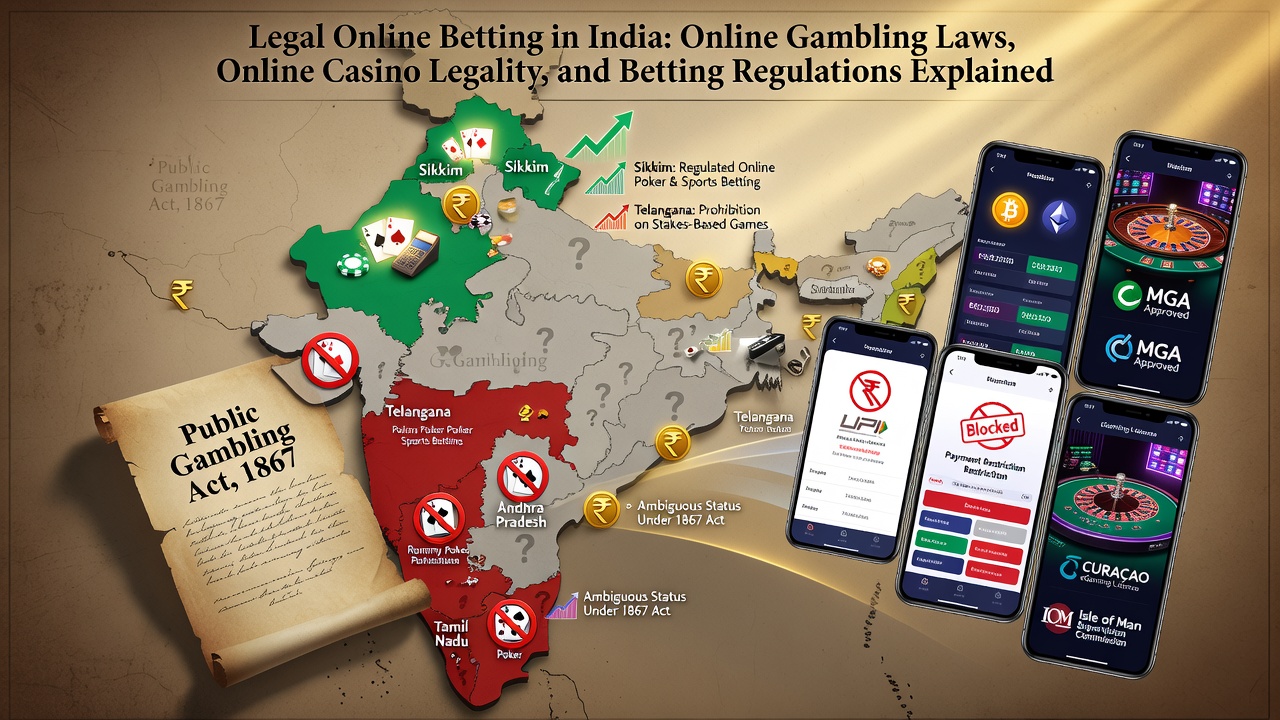
A law written in 1867, before electricity reached most Indian cities, still shapes how millions of people gamble online today. The Public Gambling Act was drafted for a country of physical gaming houses and street-corner wagers, yet courts and lawmakers continue to stretch its language to cover smartphone apps, cryptocurrency wallets, and offshore casino platforms. That gap between old statute and new technology explains why so many Indian bettors remain confused about what they can legally do with their money.
The confusion is not accidental. India does not have one gambling law; it has a patchwork of central legislation, state-specific rules, tax codes, and court rulings that often contradict each other. Someone placing a bet in Mumbai operates under different rules than someone doing the same thing in Sikkim or Goa. Before placing a single wager, it helps to understand whether is online betting and gambling legal in india depends more on where you live than on what you're betting on. That single distinction resolves most of the confusion readers bring to this topic.
This piece breaks down the legal framework state by state, explains how skill-based platforms differ from pure chance games in the eyes of the law, and clarifies what international operators can legally offer Indian users. By the end, the rules governing legal online betting in India will feel far less like a maze and far more like a map.
Understanding the Legal Framework Behind Online Betting in India
Gambling regulation in India operates on a principle that surprises many newcomers: it is fundamentally a state subject, not a central one. The Constitution places betting and gambling in the State List, meaning each of India's 28 states and 8 union territories can write its own rules. The central government's role is comparatively narrow, mostly limited to setting baseline principles and regulating specific areas like foreign exchange and information technology.
The Public Gambling Act of 1867
This colonial-era statute remains the backbone of india gambling laws online, even though it never mentions the internet. It criminalizes running or visiting a "common gaming house," a phrase courts have interpreted broadly to include some digital spaces. Several states adopted this act wholesale after independence, while others replaced it with their own versions. The law's silence on digital betting has forced judges to improvise, often relying on older precedents about physical gambling to decide modern internet disputes.
The Information Technology Act and Its Role
The IT Act of 2000 does not regulate gambling directly, but it gives the government power to block websites that violate Indian law, including unlicensed betting platforms. Internet service providers have, at various points, been directed to restrict access to specific offshore casino and betting sites. This creates a strange situation where a platform might be technically illegal to operate from India but not illegal for an individual to use, since enforcement targets operators far more often than players.
State-Specific Legislation and Variations
States such as Goa, Daman, and Sikkim have carved out exceptions permitting licensed casinos and, in Sikkim's case, regulated online gambling and sports betting for residents. Telangana, Andhra Pradesh, and Tamil Nadu have gone the opposite direction, banning online games involving stakes entirely, including some skill-based formats. This divergence means the answer to "is online gambling legal in India" genuinely changes depending on the state a person is physically located in when placing a bet.
- Sikkim: Licensed online gambling and sports betting permitted under state regulation
- Goa and Daman: Physical and some online casino operations allowed under specific licenses
- Telangana and Andhra Pradesh: Broad bans covering most online betting and gaming for stakes
- Most other states: Ambiguous or silent laws, often defaulting to the 1867 Act
Is Online Gambling Legal in India? A State-by-State Breakdown
Asking whether online gambling is legal in India as a single yes-or-no question misses the point entirely. The honest answer requires splitting the country into three rough categories: states with explicit permission, states with explicit bans, and states with no clear digital-specific law at all.
States With Explicit Legalization
Sikkim stands out as the clearest example of a state building a licensed, taxed online gambling industry. Its government issues licenses to operators offering online poker, blackjack, and sports betting to residents, treating the activity as a regulated revenue stream rather than a vice to be suppressed. Nagaland has taken a related but distinct approach, licensing skill-based online games under its Prohibition of Gambling and Promotion and Regulation of Online Gaming Act, which draws a sharp legal line between games of skill and games of chance.
States With Strict Prohibitions
Telangana's gaming laws are among the strictest in the country, banning virtually all online betting and gambling activities, including rummy and poker when played for money, regardless of the skill involved. Andhra Pradesh and Tamil Nadu have passed similar restrictive amendments, though some of these bans have faced legal challenges in court, with judges occasionally striking down provisions that fail to distinguish skill from chance.
Gray Zones and Ambiguous Regulations
Most Indian states fall into neither category cleanly. They have not passed dedicated online gambling legislation, leaving residents and operators to interpret decades-old gambling statutes as best they can. In these regions, enforcement is inconsistent, prosecutions are rare, and the practical reality often diverges sharply from the technical letter of the law. This gray zone is precisely why so many Indian users turn to offshore platforms licensed in other jurisdictions, betting that the absence of clear state law means low practical risk.
Online Casino Legality in India: What You Need to Know
Online casinos occupy a particularly contentious space within India's regulatory landscape, since most casino games rely on chance rather than skill, placing them squarely within the traditional definition of gambling that most state laws restrict.
Domestic vs. Offshore Casino Platforms
No state outside Sikkim, Goa, and Daman currently licenses domestic online casino operators. This has not stopped demand; it has simply redirected it. Millions of Indian players access offshore online casino legality in india loopholes by using platforms licensed in Malta, Curaçao, or the Isle of Man. These operators accept Indian rupees, offer customer support in Hindi and regional languages, and market aggressively to Indian audiences, all while operating entirely outside Indian jurisdiction.
Licensing Requirements for Legitimate Operators
A genuinely legitimate online casino, whether domestic or offshore, should hold a license from a recognized gaming authority. Reputable offshore licenses come from regulators in Malta, the UK, Curaçao, or Gibraltar, each with its own standards for fund security, game fairness auditing, and dispute resolution. Domestic operators in Sikkim must meet state-specific capital and infrastructure requirements before receiving authorization. Players who verify licensing before depositing money protect themselves from a significant share of the fraud risk associated with unregulated platforms.
Risks of Unregulated Casino Platforms
Unlicensed platforms offer no legal recourse if a payout is withheld or a game is rigged. Indian courts generally will not enforce claims against foreign operators with no local presence, leaving defrauded players with no practical remedy. Payment disputes, identity theft, and sudden platform shutdowns are recurring problems reported by users of low-quality offshore sites that market heavily but disclose little about ownership or regulation.
Betting and Gambling Regulations in India: Sports Betting and Skill Games
Sports betting occupies its own regulatory lane, distinct from casino gambling, largely because of how Indian courts have historically treated games of skill versus games of chance.
Cricket Betting and Its Legal Status
Cricket generates the overwhelming majority of sports betting interest in India, yet betting on cricket matches remains illegal under most state laws when conducted through unlicensed channels. High-profile match-fixing scandals in the early 2000s hardened public and judicial attitudes toward unregulated cricket betting, even as informal, illegal betting networks continued operating at enormous scale. Licensed sports betting exists legally only in states like Sikkim, where residents can place regulated wagers on cricket and other sports through authorized platforms.
Fantasy Sports and Their Unique Legal Standing
Fantasy sports platforms occupy genuinely different legal territory. Indian courts, including the Punjab and Haryana High Court, have ruled that fantasy sports involve substantial skill in team selection, statistical analysis, and strategic decision-making, distinguishing them from pure chance-based betting. This judicial reasoning has allowed fantasy sports operators to function legally across most of India, even in states with otherwise restrictive gambling laws, provided they operate under the skill-game exemption rather than as disguised betting operations.
Poker, Rummy, and Skill-Based Games
Poker and rummy sit in a legally contested middle ground. Several courts, including the Supreme Court in earlier rulings on rummy, have held that these games involve predominant skill and therefore fall outside traditional gambling prohibitions. Karnataka and Tamil Nadu, however, have specifically legislated against online rummy and poker played for stakes, overriding the general skill-game exemption within their borders. This inconsistency means a game legal in one state can be a prosecutable offense in the neighboring one.
Payment Methods, Taxation, and Financial Regulations
Even where betting itself sits in a legal gray area, the money moving through it faces very concrete regulatory scrutiny from India's financial authorities.
How Winnings Are Taxed Under Indian Law
Section 194B of the Income Tax Act mandates a flat 30% tax deduction at source on gambling and betting winnings above a modest threshold, regardless of whether the underlying activity was strictly legal. This creates an unusual dynamic: the tax authority collects revenue from betting winnings without the activity itself being uniformly legalized, treating the income as taxable first and the legality question as secondary.
RBI Regulations on Cross-Border Transactions
The Reserve Bank of India restricts the use of Indian payment rails, including UPI and standard bank transfers, for transactions with offshore gambling operators under the Foreign Exchange Management Act. This has pushed many bettors toward cryptocurrency and e-wallet intermediaries to fund offshore accounts, a workaround that carries its own legal and financial risks, including potential scrutiny under money laundering regulations.
Safe Payment Practices for Bettors
Anyone engaging in legal online betting in India through a licensed domestic platform should rely exclusively on documented, traceable payment methods and retain transaction records for tax reporting purposes. Avoiding intermediary services that obscure the origin or destination of funds reduces exposure to both fraud and regulatory action.
- Use licensed platforms with transparent payment processing
- Retain records of deposits and withdrawals for tax filing
- Avoid third-party payment aggregators that mask transaction origins
- Report winnings honestly under Section 194B requirements
Practical Guidance for Bettors Navigating India's Legal Landscape
Given the fragmented nature of betting and gambling regulations in India, practical caution matters more than theoretical legal debate for most individual bettors.
Verifying a Platform's Legitimacy Before Betting
Check the operator's licensing jurisdiction, read independent reviews focused specifically on payout reliability, and confirm the platform discloses a real corporate address and regulatory body. Platforms that hide ownership information or licensing details warrant immediate suspicion.
Understanding Your State's Specific Rules
Because gambling law varies so dramatically by state, residents should check their specific state's amendments to the Public Gambling Act or any dedicated online gaming legislation before assuming a national rule applies uniformly. What is permitted in Sikkim may carry criminal liability in Telangana.
Recognizing Red Flags of Illegal or Fraudulent Operators
Unrealistic bonus promises, refusal to process withdrawals, lack of identity verification procedures, and absence of any visible licensing information are consistent warning signs across fraudulent betting and casino platforms targeting Indian users.
Frequently Asked Questions
Can I be arrested for placing a bet online in India?
Enforcement against individual bettors is rare compared to action against operators, but the legal risk technically exists in states with strict prohibitions like Telangana and Andhra Pradesh. In states with licensed frameworks like Sikkim, betting through authorized platforms carries no criminal exposure.
Are offshore betting sites safe to use if they accept Indian players?
Safety depends entirely on the operator's actual licensing, not on whether it accepts rupees or Indian payment methods. A site licensed by a recognized authority with a verifiable track record is far safer than one with no disclosed regulator, even though both may be technically outside Indian jurisdiction.
Do I have to pay tax on money won through online betting?
Yes. Section 194B requires a 30% tax deduction on winnings above the specified threshold, and this obligation applies regardless of which state you live in or whether the platform itself is domestic or offshore.
Is fantasy cricket considered gambling under Indian law?
No. Courts have consistently classified fantasy sports as skill-based contests rather than gambling, which is why platforms offering fantasy cricket and other fantasy sports operate legally across most Indian states, including several that ban traditional betting outright.
Why does gambling law differ so much between Indian states?
Gambling falls under the State List in the Constitution, giving each state authority to legislate independently. This has produced a patchwork where neighboring states can have entirely opposite rules on the same activity.
What should I check before depositing money on an online casino?
Confirm the operator holds a valid license from a recognized gaming authority, review its history of processing withdrawals, and verify it discloses real corporate ownership details. Avoid any platform that cannot provide this information clearly and promptly.