
Mines Game Strategy: Casino Odds, Payout Percentage, and Probability Calculator Guide
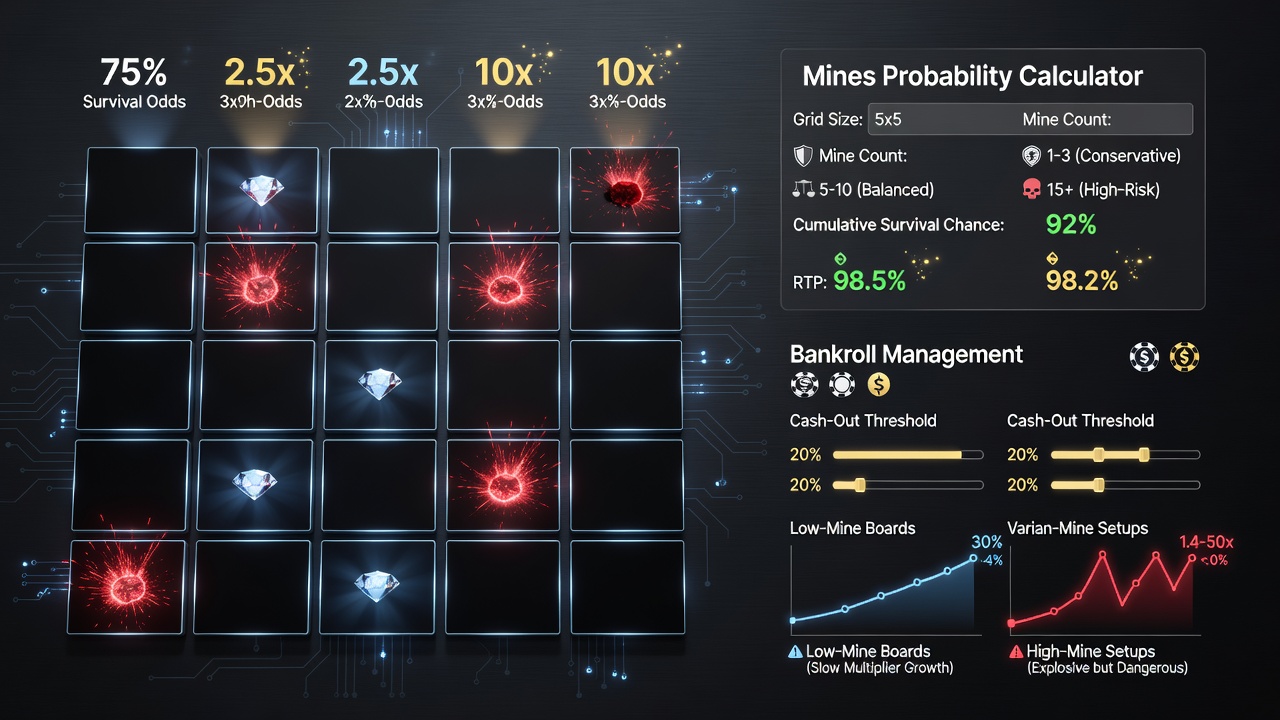
A single misclick on a five-mine board with twenty tiles remaining carries roughly a 25% chance of ending the round instantly. That number rarely registers with players until they've already lost a streak of rounds chasing a multiplier that felt "almost guaranteed." The mines casino game looks deceptively simple: a grid, hidden bombs, and a growing multiplier for every safe tile you reveal. But underneath that simplicity sits a rigid mathematical structure that determines exactly how much risk you're taking with every click.
Most players approach the game emotionally, adjusting their bets based on gut feeling rather than the actual shifting probabilities behind each tile. That's a mistake, because the odds in this game are not static - they change with every reveal, and understanding that shift is the difference between a calculated wager and a blind guess. Anyone serious about improving their results should study how mines gambling odds are calculated before increasing stake size, and platforms offering a full details breakdown of payout tables can save hours of manual calculation. This guide walks through the mechanics, the math, and the practical strategy adjustments that separate disciplined players from those relying purely on luck.
Understanding the Mines Casino Game Mechanics
How the Grid and Mine Placement Work
The standard mines casino game presents a grid - typically 5x5, giving 25 tiles total - where a player selects how many mines to hide before the round starts. Once the round begins, mine positions are fixed using a random number generator, and they do not move or change based on player behavior. Selecting a higher mine count increases the danger of every click but also inflates the multiplier growth rate, since fewer safe tiles remain to distribute the same overall risk.
The Role of Random Number Generation
Every reputable mines casino game runs on a certified random number generator, meaning outcomes are not influenced by previous rounds, time of day, or betting patterns. This is a critical point: there is no "hot" or "cold" grid. Each new round is a fresh probability event, independent of what happened before. Players who believe a grid is "due" for a mine-free stretch are misreading how RNG systems function.
Multiplier Growth and Risk Correlation
The multiplier increases with each safe tile revealed, and the rate of increase is directly tied to how many mines are on the board. A three-mine board grows multipliers slowly but safely; a twenty-mine board grows them explosively but with brutal risk. This relationship is the foundation of any serious mines game strategy - you're not just choosing how many tiles to click, you're choosing a risk curve.
Calculating Mines Gambling Odds
Basic Probability Formulas for Each Click
The odds of hitting a safe tile on any given click are calculated as the number of remaining safe tiles divided by the number of remaining unrevealed tiles. If a 25-tile grid has 5 mines and you've already revealed 5 safe tiles, you have 15 safe tiles and 5 mines left among 20 unrevealed spots - a 75% chance of survival on the next click. That percentage drops with every additional reveal, since mines become a larger proportion of what's left.
How Odds Shift as You Reveal More Tiles
This is where many players miscalculate. The odds don't stay constant just because the first few clicks were safe. As the safe tile count shrinks, the probability of hitting a mine on the next click rises sharply, especially in the later stages of a round. A grid that started with 80% safe odds can drop below 40% by the time only a handful of tiles remain.
Comparing Odds Across Different Mine Counts
- 1-3 mines: high survival odds per click, slow multiplier growth, suited to conservative play
- 5-10 mines: moderate risk, balanced multiplier curve, the most commonly chosen range
- 15+ mines: steep risk per click, rapid multiplier escalation, suited only to high-tolerance bettors
Mines Payout Percentage Explained
How RTP Is Structured in Mines
The mines payout percentage - often referred to as return to player, or RTP - represents the theoretical average return across a large number of rounds. Most mines implementations sit in a range comparable to other online casino games, generally between 96% and 99%, though the exact figure depends on the platform's configuration and the mine count selected. Higher mine counts don't necessarily mean lower RTP; they mean higher variance, which is a different concept entirely.
Variance vs. Payout Percentage
Payout percentage tells you what happens over thousands of rounds. Variance tells you what happens in your session tonight. A game can have a 97% theoretical payout percentage and still produce a losing streak lasting dozens of rounds, because variance describes the swing between outcomes, not the long-run average. Players confusing these two concepts often misjudge how "fair" a session felt.
Why Payout Rates Differ Between Platforms
Not every operator configures the mines casino game identically. Some adjust the underlying payout tables slightly, which shifts the effective mines payout percentage even though the visible mechanics look the same. This is why comparing platforms before committing significant bankroll matters - a few percentage points in RTP compound meaningfully over hundreds of rounds.
Using a Mines Probability Calculator
What These Tools Actually Calculate
A mines probability calculator takes three inputs - grid size, mine count, and tiles already revealed - and outputs the exact percentage chance of survival on the next click, along with the corresponding multiplier. These tools remove guesswork entirely, replacing intuition with a hard number you can act on before every decision.
Step-by-Step: Reading Calculator Output
Most calculators display three figures: current survival probability, next-click multiplier if you continue, and cumulative probability of reaching a specific future tile count without hitting a mine. The third figure is often the most useful, since it shows the true odds of hitting your target cash-out point rather than just the next single click.
Common Mistakes When Interpreting Probability Data
Players frequently confuse "probability of the next click" with "probability of finishing the round successfully." These are very different numbers. A 90% chance on the next click does not mean a 90% chance of reaching your intended cash-out five tiles later - cumulative risk compounds with every additional click.
Building an Effective Mines Game Strategy
Conservative vs. Aggressive Approaches
A conservative mines game strategy favors low mine counts, frequent small cash-outs, and steady bankroll preservation. An aggressive approach chases high multipliers with elevated mine counts, accepting more frequent losses in exchange for occasional large wins. Neither approach is objectively superior - the right choice depends on bankroll size, session goals, and personal risk tolerance.
Setting Cash-Out Thresholds Based on Probability
Disciplined players set a target multiplier before the round starts and cash out the moment it's reached, regardless of how tempting the next click looks. Using probability data to set this threshold - rather than picking a number arbitrarily - keeps decisions grounded in math rather than emotion.
Bankroll Management Techniques for Mines
- Set a fixed loss limit per session and stop when it's reached
- Scale bet size to a small percentage of total bankroll, not a fixed dollar amount
- Avoid increasing mine count after losses in an attempt to "win back" faster
Adjusting Strategy Based on Session Goals
A player aiming for steady, incremental gains should stick to low-mine grids and modest multipliers. A player chasing a single large payout in a short session might accept higher variance deliberately. Matching strategy to goal prevents the common error of playing a high-risk style while expecting low-risk consistency.
Frequently Asked Questions
Is the mines casino game purely luck, or does strategy matter?
Outcomes are determined by random number generation, so no strategy changes the odds of any individual click. Strategy matters because it controls bet sizing, mine count selection, and cash-out timing - all of which shape long-term results even though each click itself is random.
What mine count offers the best balance of risk and reward?
Most experienced players settle in the 3-to-7 mine range, since it offers meaningful multiplier growth without the extreme volatility of higher counts. The "best" count ultimately depends on how much variance you're comfortable absorbing in a single session.
Can a mines probability calculator improve my actual win rate?
It won't change the underlying odds, but it removes guesswork from your cash-out timing, which helps you avoid clicking past the point where risk outweighs potential reward. Consistent use tends to reduce impulsive decisions more than it increases raw win percentage.
Why does the mines payout percentage vary between platforms?
Different operators configure their payout tables and RTP settings independently, even when the visible game mechanics appear identical. Checking the stated RTP before playing helps you choose platforms with more favorable long-term returns.
Does increasing the mine count always mean lower expected returns?
Not necessarily - it means higher variance and steeper risk per click, but the theoretical payout percentage can remain similar across mine counts depending on how the platform structures its multiplier tables. Higher mine counts simply concentrate the same overall risk into fewer, larger swings.
How many tiles should I reveal before cashing out?
There's no universal number - it depends on your mine count, risk tolerance, and target multiplier set before the round began. A useful discipline is deciding your cash-out point in advance and sticking to it rather than reacting to how the round feels in the moment.